The Global Labour Dispute in the Health Care System
Why nurses are on strike worldwide.
International

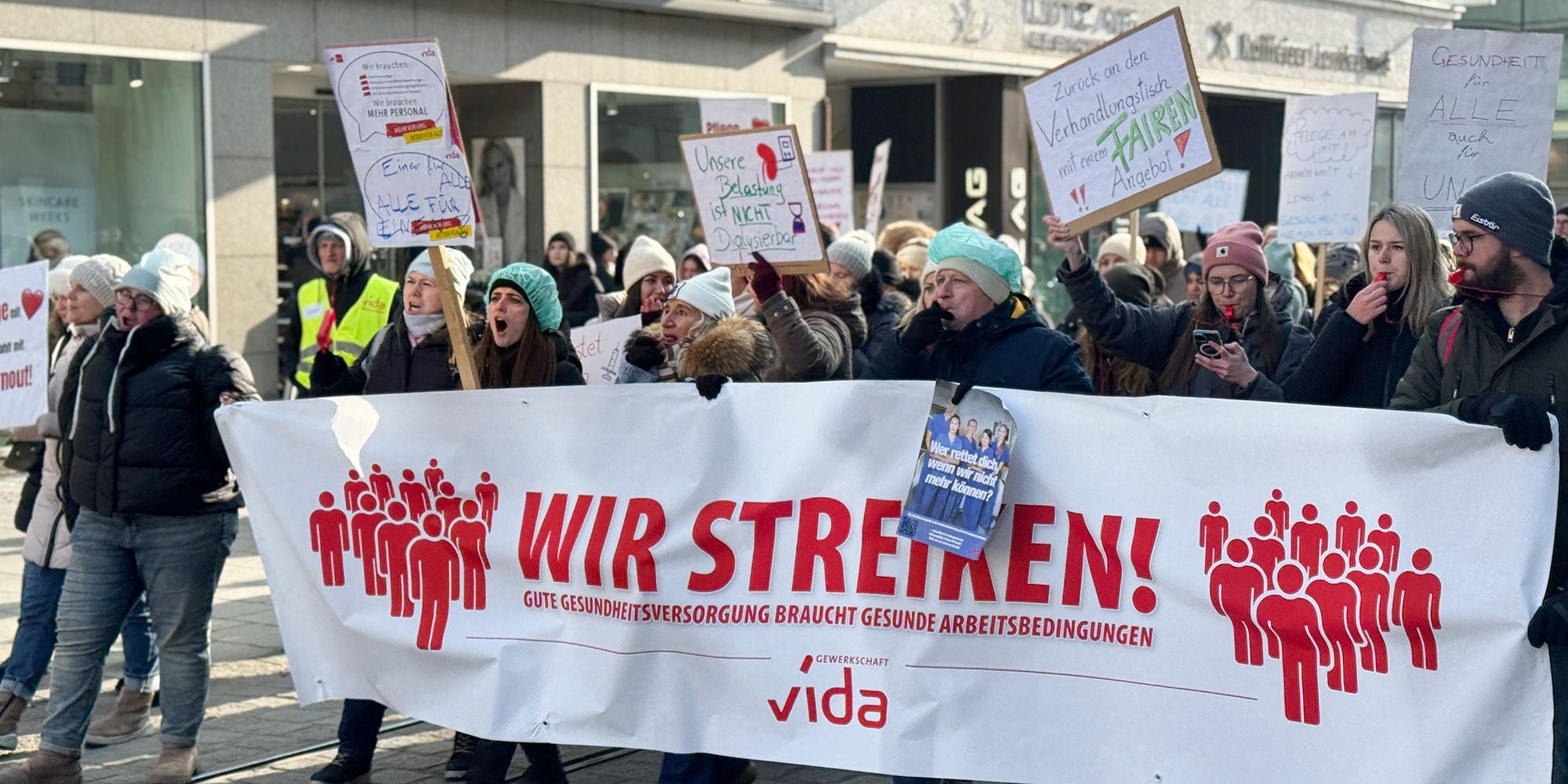
Whether in New York, Upper Austria or elsewhere: When nurses go on strike, it is no longer about individual issues or regional peculiarities.
Rather, the current labor disputes of the New York nurses and the demands of employees in the Austrian health care system show a global pattern. Overwork, staff shortages and chronic underfunding are no coincidence – they are inherent in the system.
Same problems despite different systems
At first glance, the health care systems could hardly be more different: on the one hand, the strongly market-oriented US system, on the other, the Austrian model, which is organized on the basis of social partnership. But the reality in the hospitals tells a different story.
Nurses in both countries report:
- Chronic staff shortage
- Extremely high workload
- increasing mental and physical stress
- a payment that does not keep pace with responsibility and burden
Largest nursing strike in New York's history
Source: Eyewitness News ABC7NY | YouTube
On January 12, 2026, around 15,000 registered nurses in New York City entered the largest nursing strike in the city's history.
The industrial action affects employees of the three large private hospital systems Mount Sinai, Montefiore and New York-Presbyterian.
As of today, January 24, 2026, nurses are on strike for fair working conditions for the 12th day.

New York's largest trade union and professional body for qualified nurses.
The strike of the New York nurses is centrally directed against unsafe staffing and unbearable workloads. It is precisely these points that are also at the centre of trade union demands in Austria – for example in religious hospitals, private hospitals or the social economy.
Overload is not an industrial accident
The narrative that overload is a consequence of crises, staff shortages or short-term bottlenecks falls short. In fact, it is structurally produced.
In recent decades, healthcare systems around the world have been restructured according to business criteria:
- Cost containment instead of quality of care
- Efficiency metrics instead of time spent on patients
- Personnel savings instead of sustainable personnel planning
Care work is often considered a "cost factor", not a supporting pillar of public services. The result is similar everywhere: employees are working at the limit – and beyond.
When nurses strike, the system goes on strike
Both in New York and in Austria, nurses are reflexively accused of irresponsibility during strikes. This is not only wrong, but cynical.
In fact, strikes make visible what is often concealed in everyday life:
A system that only works because employees constantly go beyond their limits is not a functioning system.
Nurses strike not despite, but because of their responsibility:
- for patients
- for colleagues
- for health care worthy of the name
Global crisis, global lessons
The parallels between the labour disputes show that these are not national outliers, but a global crisis in health work. Different systems, same logic – and the same consequences.
What is needed is a fundamental change of course:
- Binding personnel standards instead of whitewashing
- Working time models that enable healthy working
- Wages that reflect qualifications and workload
- and a clear political decision against austerity in the health care system
Health is not a commodity
The struggles of the New York nurses and the workers in Austria send the same message: health must not be organized according to market logic.
As long as profits, budget caps and "efficiency programs" are placed above people, overload will not remain an exception, but the norm. If you want to change this, you have to start where the problem arises – in the system itself.