KV negotiations cleaning 2024
The collective agreement for monument, façade and building cleaners was concluded for three years. At least 3.8 percent wage increase.
KV negotiation
We have a degree
After four rounds of negotiations, an agreement was reached on Tuesday in the area of monument, façade and building cleaning. The collective agreement, which applies to around 54,000 employees, stipulates an increase in gross hourly wages of at least 3.8 percent from January 1, 2025. This corresponds to the value of rolling inflation. The minimum wage in the industry will thus rise to just under 2,080 euros, while apprentices will start with 1,028 euros in the first year of training, which is 6.5 percent more than in the previous year.
Lower wage groups benefit
A major feature of the new cleaning collective agreement is that it is valid for three years. By 2027, the wage groups will be gradually reduced from six to four, which will benefit employees with lower incomes. "It is particularly pleasing that the remuneration in maintenance cleaning will increase in the long term. This sector is mainly employed by women – many of them migrants – who have to work part-time due to family circumstances, but much more so because of industry-specific circumstances," says Ursula Woditschka, negotiator for the trade union vida.
Simplification creates transparency
Woditschka is sure that the new wage group scheme has another advantage: With this redefinition of the wage groups, the classification will be clearer and more transparent. This allows employees to better understand what they are entitled to and to demand it. "This will also reduce price dumping between companies. After all, only those orderly companies that treat their employees fairly should be given a chance in tenders."
More full-time for women
Another novelty in the new cleaning collective agreement is the calculation to the extent of six months in all areas except hotel cleaning. Overtime is therefore only paid if it has not been compensated with compensatory time within six months. Since this regulation only applies to full-time employees, it should lead to more full-time jobs finally being offered in cleaning. "Currently, this industry is mainly working part-time workers with a low number of hours - and that has to change. Many cleaners would like to work more. With more full-time work in this industry, which is dominated by women, we will be able to ensure that more women can live on their income," emphasizes vida trade unionist Woditschka.
Update November 28, 2024
For the fourth round of collective bargaining for the cleaning industry, the employees made it clear with an action: wage increases worth a slice of bread are not enough.
On Thursday, the fourth negotiation date on the collective agreement for the cleaning industry took place. Employers had recently shown little willingness to compromise. Therefore, the employees, together with vida officials, surprised them with a special "welcome reception" before the start of the negotiation round.
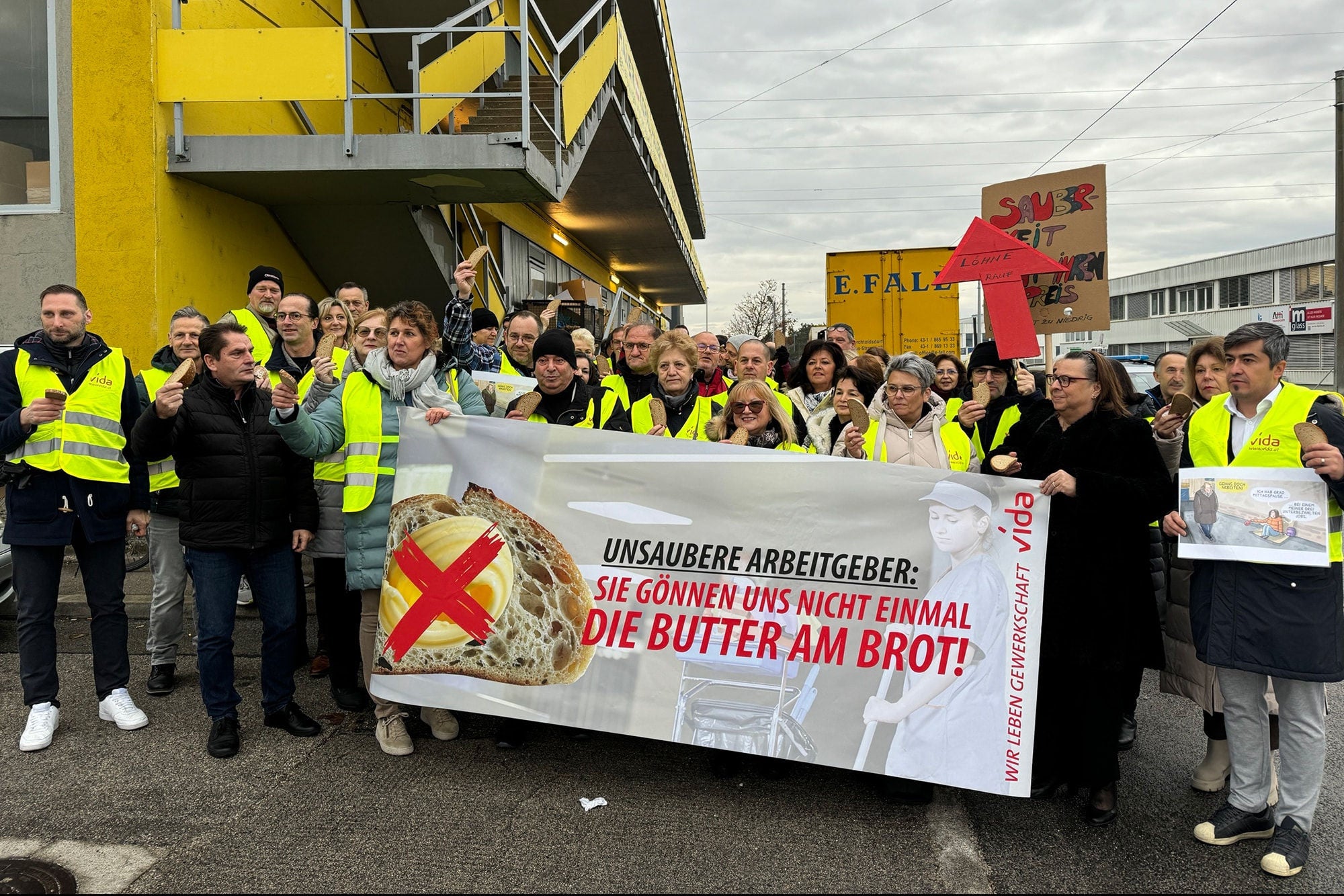
Around fifty people, equipped with high-visibility vests and posters, gathered at the entrance to the cleaning academy, where the negotiations were to take place. When the employers arrived, they were immediately confronted with the message of the protesters: "Unclean employers: They don't even begrudge us the butter on the bread!". This illustrated that the wage increases offered so far have just the value of a dry slice of bread.
The cleaning industry is strongly female and immigrant, many work part-time, and wages are comparatively low. The collective agreement negotiations for monument, façade and building cleaning are therefore about preventing poverty among working people. Because no one can live on bread alone.
Update November 13, 2024
The collective agreement negotiations for the employees of the Monument, Façade and Building Cleaning (DFG) have not brought an agreement in the third round either. The employers are currently offering a 3.8 percent wage increase, which only covers inflation. According to the employers, urgently needed reforms of working conditions - with high part-time quotas, a high proportion of women and unfavourable working hours - should remain unchanged or even worsened . Specifically, the employers propose an annual calculation of working hours, which would hardly define overtime as such and be compensated.
Cleaning industry at a low level
vida chairman Roman Hebenstreit sharply criticises the employers' lack of willingness to compromise: "As far as the further development and attractiveness of their sectoral collective agreement is concerned, they are blocking any change. In doing so, they impose enormous burdens on employees and also shoot themselves in the foot." Wages and working conditions at the DFG are already at a low level. "If measures are then pushed that de facto deprive employees of their overtime bonuses, the cleaning industry will soon be hard to beat in terms of unattractiveness ," said the vida trade unionist.
Employers are on a downward spiral
Improvements for cleaners - both in terms of wages and general conditions - are indispensable, according to Hebenstreit.
"Employers are diligently turning the downward spiral. In Austria, private consumer spending has always been a stabilizer. A strong turbo is needed, especially in the low-paid industries. At the same time, employers are complaining about a decline in orders. Obviously, they need tutoring in economic contexts: orders come through confidence and consumption. This requires incomes that make this possible."
"If the employers' side continues to rule out improvements, we cannot guarantee that the negotiations will come to a conclusion," said vida chairman Roman Hebenstreit.
The next round of negotiations for the cleaning collective agreement is scheduled for 28 November.
Update October 24, 2024
On 24 October 2024, the second collective bargaining negotiation date took place in the field of monument, façade and building cleaning (DFG). As expected, the negotiators have not yet been able to conclude the collective agreement. Ursula Woditschka, negotiator for the trade union vida, is particularly critical of the fact that the employers' side wants to conclude a contract for 80 percent of employees below rolling inflation , which is 3.9 percent. The current offer for four out of six wage groups is 3.3 percent. "This would mean that most cleaners would lose their wages in real terms. As employee representatives, we cannot agree to this under any circumstances," said the vida trade unionist.
Women's Cleaning Industry
Even in the context of Equal Pay Day, which falls on November 1 throughout Austria this year, it is important not to leave cleaning employees in the lurch. DFG is a strongly female industry. Of the approximately 54,000 employees, two-thirds are women. And of these, two-thirds are employed part-time.
"These women are already struggling to make a living. Their part-time wages are low and their days are often torn up because of shared services. If they go to work twice a day – once early in the morning and then late in the evening – they incur additional costs that no one reimburses them. You can't save anything here."
Hope for agreement
Despite the currently hardened fronts between the collective bargaining teams , according to Woditschka , there is still reason to hope that an agreement will be reached from which the cleaners will also benefit. But: "If the employers do not move in our direction, we will inform the works councils as the next step," the trade unionist says determinedly.