The real fight behind the Samsung strike: Who owns the profits?
Why trade unions are the most important counterweight to global corporations.
International
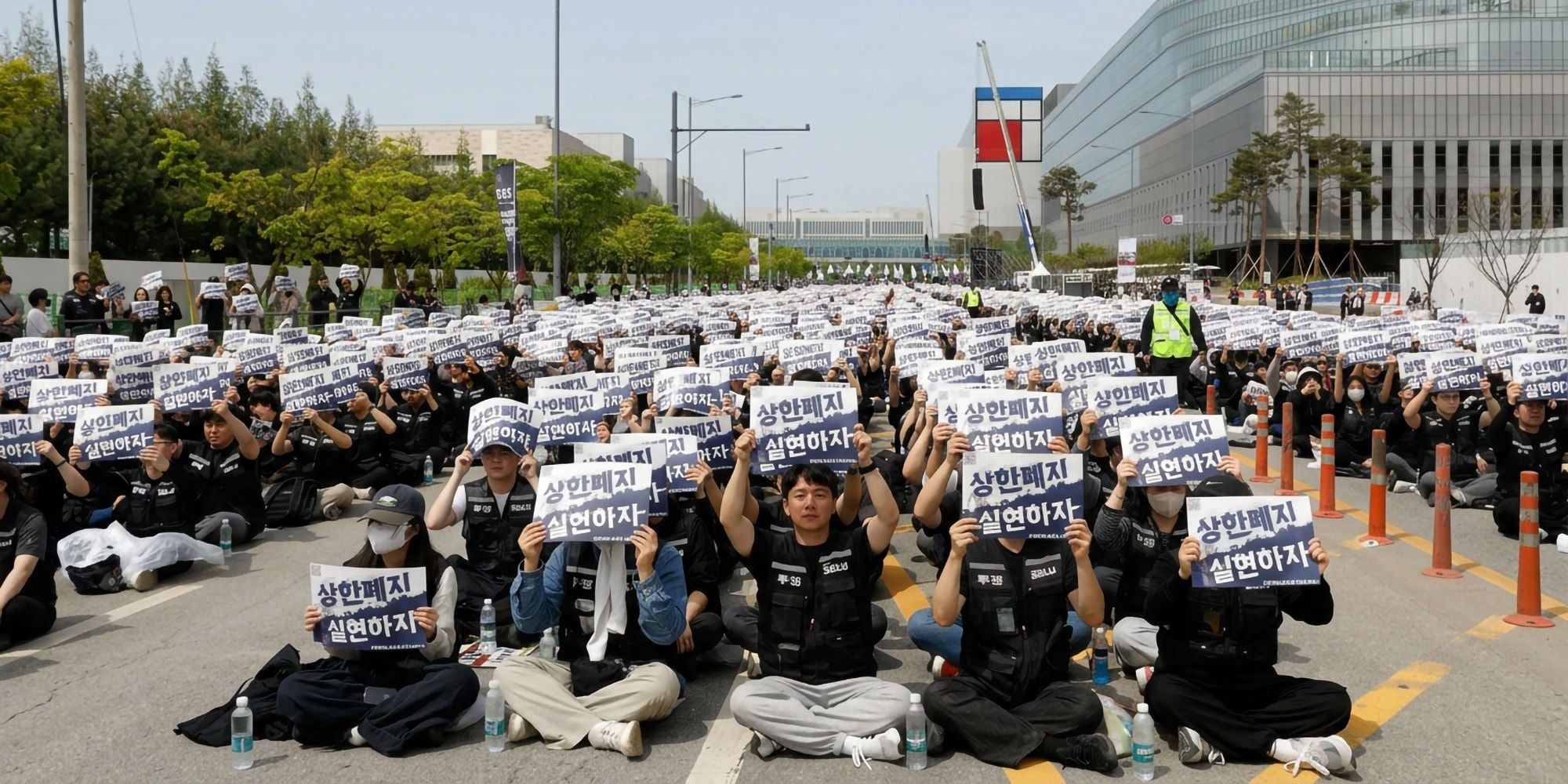
The South Korean technology group Samsung Electronics is facing the biggest strike in the company's history. Thousands of employees are demanding a fair share of the company's enormous profits. While Samsung is making billions in profits thanks to the global AI boom, employees are demanding more than mere words of thanks and symbolic bonuses: they want a fair share of the success they themselves achieve every day.
But the conflict is much more than an internal dispute in South Korea. It is an example of why strong trade unions are indispensable worldwide if employees are to participate in economic success.
Source: Reuters | YouTube
Profits are globalised – workers' rights often are not
International corporations have long been operating globally. Production chains span several continents, profits flow internationally and shareholders worldwide benefit from rising company values. Workers' rights, on the other hand, often remain nationally limited – and thus significantly weaker.
This is precisely why trade union organisation is becoming more and more important internationally. After all, individual employees have hardly anything to oppose multinational corporations. Only through collective organization does bargaining power arise.
The conflict at Samsung clearly shows this: For decades, the company was considered anti-union. Employee representatives were systematically obstructed, critical employees were put under pressure. It is only in recent years that trade unions have managed to organise themselves more strongly and build up serious pressure. The fact that profit-sharing is being negotiated at all today is no coincidence – but the result of union organizing.
Fair profit sharing does not fall from the sky
Companies often argue that high profits are the result of innovation, management decisions or market strategies. In fact, however, economic success comes from the daily work of millions of employees – in factories, care facilities, hotels, trains or logistics centres.
Nevertheless, a similar pattern emerges worldwide: productivity and profits are rising, while many workers are struggling with real wage losses, increasing workloads or unsafe working conditions.
Historically, the fact that employees can change something about this is almost always the result of trade union struggles. Whether it was a reduction in working hours, holiday entitlements, overtime regulations, Christmas bonuses or wage increases – social progress was rarely granted voluntarily. They had to be organized and collectively fought for.
Profit sharing is therefore not a question of the generosity of corporations, but a question of power.
AI boom and record profits exacerbate the question of distribution
This development is currently particularly visible in the technology industry. Companies are benefiting massively from the boom in artificial intelligence, automation and digitalization. At the same time, there is growing concern among many employees that productivity gains will end up almost exclusively with owners and capital markets.
The International Monetary Fund recently warned that AI could further exacerbate existing inequalities if productivity gains are not distributed more widely.
This is precisely why the question of profit sharing is gaining in importance. If new technologies enable enormous profits, the people who make this development possible in the first place with their work must also benefit.
Trade unions as an international countervailing power
The strike at Samsung shows that trade unions today are much more than national interest groups. They create international solidarity and common standards in a globalised economy.
This is because corporations often exploit international competition in a targeted manner: employees and locations are played off against each other, labor costs are depressed and rights are undermined. Without strong unions, there will be a race to the bottom – in terms of wages, working conditions and social security.
International trade union networking is therefore crucial in order to enforce minimum standards and demand a fair share of economic success. This question will become even more important in the future, especially in export-oriented industries or global technology companies.
Economic progress needs social justice
The dispute at Samsung is ultimately a symbol of a larger social question: Who owns economic progress?
When companies make billions in profits, while employees hardly benefit from success despite rising productivity, social inequality grows. Trade unions are therefore not only negotiating partners for wages and working hours. They are a democratic counterweight to economic power.
The conflict in South Korea shows that fair profit-sharing is created where employees are organized and can build up pressure together. Without trade unions, "joint success" often remains just a slogan from corporate communications.
Good reasons to become a member right now
- You strengthen the bargaining power – the more we are, the better the collective agreements.
- Legal protection and advice when things get serious.
- Co-determination in the company: You give weight to your voice.
- Continuing education and networking: Sharing knowledge, learning strategies, winning together.
- All the benefits of a large community
- Solidarity that carries – even when things get uncomfortable.

Do you want negotiations to take place on an equal footing again – with results that reach your wallet?