Alliance for a fair contribution of the richest
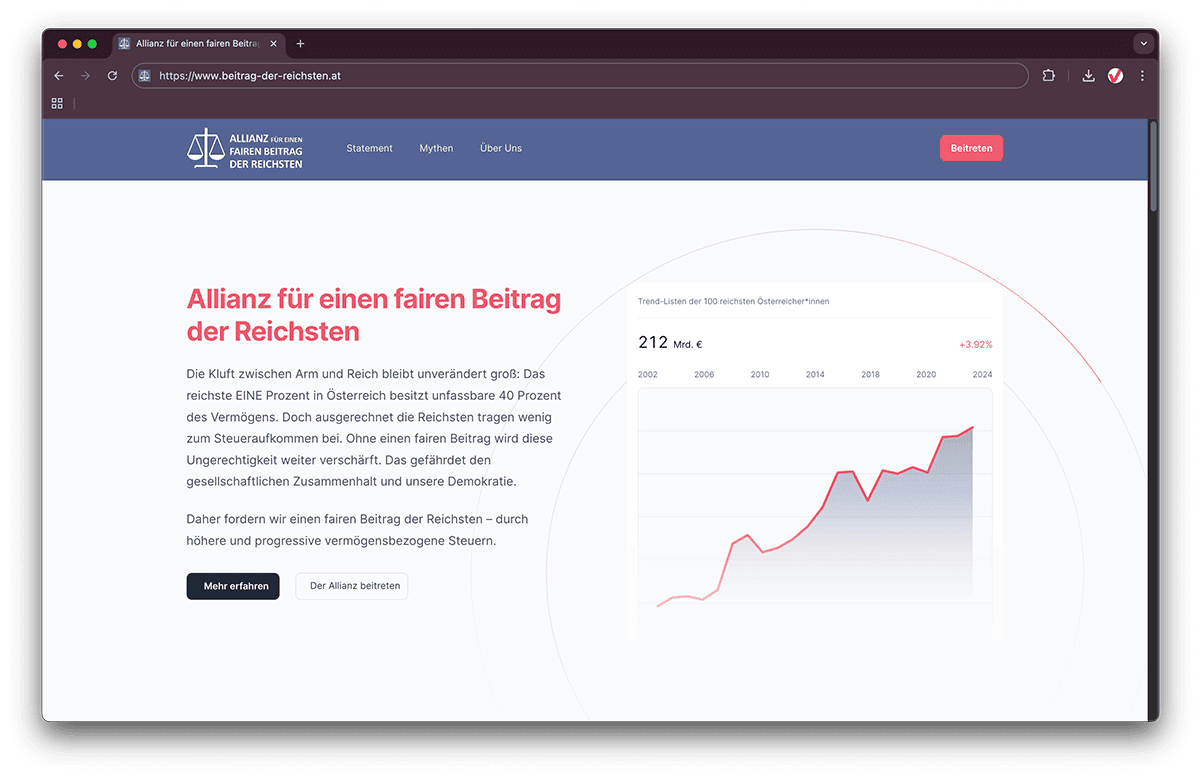
The gap between rich and poor remains wide: The richest ONE percent in Austria owns an incredible 40 percent of the wealth. But the richest of all people contribute little to the tax revenue. Without a fair contribution, this injustice will be further exacerbated.
Justice

Taxing wealth fairly: Why fair wealth taxation is essential for democracy and society
Fortunes are growing – but they are growing mainly for a few. While a small part of the population accumulates ever larger wealth holdings, broad sections of society continue to bear the majority of the tax burden.
This development is not only a question of justice, but also a challenge for democracy, the economy and social cohesion. Numerous studies and economic analyses show that fairer taxation of large fortunes is necessary to limit extreme inequality and secure public investment.

Alliance for a fair contribution of the richest
We demand a fair contribution from the richest – through higher and progressive wealth-related taxes.
Concentration of wealth reaches historic proportions
Today, the distribution of wealth is much more unequal than the distribution of income. In Austria, the richest one percent of the population owns around 40 percent of the total wealth, while the poorer half has hardly any assets worth mentioning.
A similar development is also evident internationally: The richest ten percent hold more than half of the wealth in many industrialized countries. This concentration is not a random result, but the result of political decisions, economic structures and tax frameworks.
Economist Thomas Piketty uses historical data to show that wealth grows faster than the economy itself in the long term. As a result, inequality will automatically increase if no political countermeasures are taken.
In addition, large fortunes are often not created through work, but through inheritances and investment income. This means that the "birth lottery" is increasingly deciding who gets rich.
The super-rich pay less tax than the middle class
A central problem is the actual tax burden on very high assets and incomes. Although progressive income tax systems exist in many countries, they do not work in practice, especially for the richest.
Analyses show that the effective tax rates of billionaires are significantly lower than the statutory top tax rates. While a middle-class family in Austria bears about 42 percent of its income in taxes and contributions , the effective contribution of multimillionaires is significantly lower.
The reason for this is mainly due to special tax rules and privileges for capital and property income. These are often taxed at a flat rate – regardless of the amount of income – while earned income is taxed progressively.
This leads to a paradoxical situation:
People with very high property incomes often pay less tax than employees with high incomes.
Austria is at the bottom of the list when it comes to wealth taxes
Another factor is the low importance of wealth-related taxes in the Austrian tax system.
Today, only about 1.1 percent of total tax revenue comes from wealth taxes. The OECD average, on the other hand, is 5.6 percent – more than four times as high.
Historically, it was different:
As recently as the 1960s, wealth-related taxes accounted for around four percent of tax revenue. With the abolition of wealth tax and inheritance tax, this share fell drastically.
Today, the Austrian tax system is financed primarily through taxes on labour and consumption – i.e. through those groups that own fewer assets anyway.

Inequality endangers democracy and economic stability
Extreme concentration of wealth has not only economic but also political effects. Large fortunes create political influence – for example through lobbying, party donations or economic power structures.
Studies show that very wealthy individuals have easier access to political decision-makers and can assert their interests more strongly.
This development can distort democratic processes. When economic power becomes political influence, the principle of "one person, one vote" comes under pressure.
In addition, extreme concentration of wealth also causes economic problems:
- lower consumer demand
- increased financial speculation
- Higher vulnerability to crises
- increasing pressure on employees and public services
Wealth taxes as an instrument for more justice
Many economists see stronger taxation of large fortunes as an important instrument against growing inequality.
Possible measures include:
- progressive wealth taxes on large fortunes
- Taxation of inheritances of large transfers of assets
- Progressive taxation of capital gains
- International cooperation against tax evasion
Models show that a wealth tax could generate considerable revenue. According to estimates, several billion euros could be available annually for public investment in Austria alone.
These funds could be invested, for example, in education, health, care or climate protection.
A question of political priorities
The debate on wealth taxes is ultimately not a technical question, but a political one. However, economic research clearly shows that instruments for fairer taxation exist.
The decisive question is therefore not whether greater taxation of large fortunes is possible – but whether it is politically wanted.
A democratic society thrives on everyone contributing to the common good according to their economic capacity. A fair taxation of large fortunes is therefore not an ideological project, but a prerequisite for social cohesion and a functioning democracy.