Heavy labour in care: Commitment of the trade union vida works
Years of union involvement enable nurses to retire earlier.
Nursing is hard work
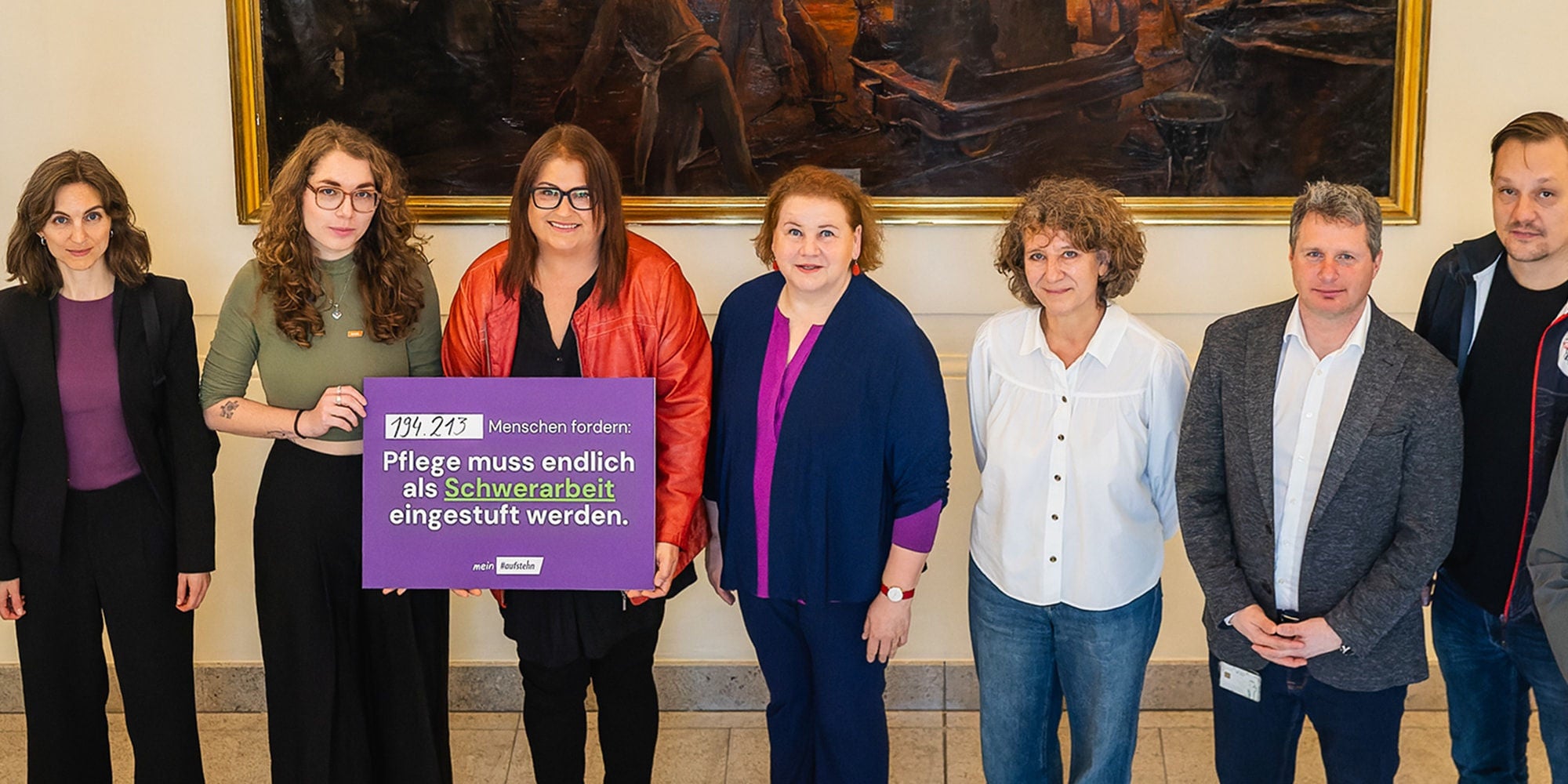
With a petition signed by over 190,000 people, trade unionists and committed nurses reiterated the demand to classify care as hard work.
The fact that care is to be classified as hard work has long been beyond question for the employees and their representatives. The trade union vida, which represents, among other things, employees in private hospitals, religious hospitals, mobile care, disabled and rehabilitation facilities, has been calling for better access to heavy labour pensions for nurses for years. With numerous protest actions, vida trade unionists, works councillors and colleagues in solidarity repeatedly emphasised this demand. Now the union commitment is having an effect: Social Affairs Minister Korinna Schumann and ÖVP club chairman August Wöginger announced in a press conference in April that the heavy labour regulation for nursing staff would be reformed as of 1 January 2026.
"This commitment by the Federal Government is a success for all those who support our health system with commitment and expertise. And it shows that our political work is working," said Gerald Mjka, deputy chairman of the vida trade union, and Sylvia Gassner, chairwoman of the vida social services department. It is also clearly anchored in the current government programme that nursing is recognised as hard work.
"Dealing with people in exceptional situations, with illness and death is at least as strenuous as irregular night work or lifting patients."
Easier access to previous pension
Until now, nurses have had to work 15 shifts per month for at least ten years in order to be entitled to a heavy labour pension. However, due to long service hours and complex duty rosters, this extent is hardly achievable for many. In the future, the time load will no longer be calculated by shifts, but by hours. In addition, the previous focus on physical stress will be expanded to include psychological and multiple stresses.
"Dealing with people in exceptional situations, with illness and death is at least as strenuous as irregular night work or lifting patients," explains Mjka, who works as a qualified nurse in addition to his trade union activities. The fact that these factors are to be recognised in the future is "right and overdue".
"For the new regulations to actually take effect, the federal government must quickly take concrete measures. For example, different types of training must be taken into account when calculating the relevant insurance periods."
Concrete measures are needed now
For Gassner, the reform is an important first step. "However, what is ultimately in the law is decisive. In order for the new regulations to actually take effect, the federal government must quickly take concrete measures," emphasizes the vida trade unionist.
"When calculating the relevant insurance periods, for example, different types of training must also be taken into account," Gassner goes into detail. In order to best reflect the interests of nursing staff in the heavy labour regulation, the trade union vida will try to change open points in the government programme in a positive direction.